Our colleagues from the National University of Science and Technology POLITEHNICA Bucharest in Romania informed the international audience at EEPES 2025 Conference – International Conference on Engineering Physics, Electronics and Earth Science (EEPES 2025) - about the results achieved to forecast inflows into the cascade system of the Aliakmon River in Northern Greece.
1. Intelligent asset management platform for hydropower operation and maintenance - iAMP-Hydro
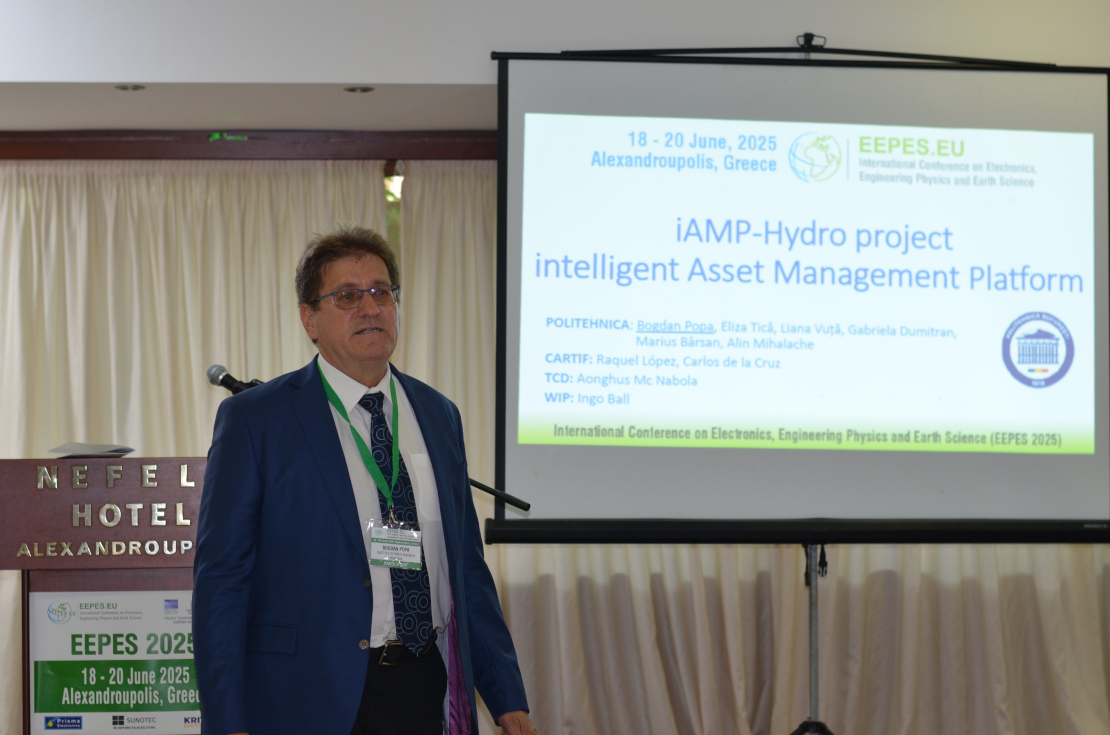
Bogdan Popa, informing about the iAMP-Hydro project
Professor Bogdan Popa from the National University of Science and Technology POLITEHNICA Bucharest in Romania, and working also as iAMP-Hydro project partner presented on 19 June 2025 the whole project at the EEPES conference, and informed the audience about interesting contributions from two colleagues who presented two papers during the session: Renewable Energy and Green Technologies 1, which took place earlier that day.
See the full presentation HERE.
2. Modelling inflows in Ilarion reservoir, Greece, using HEC-HMS
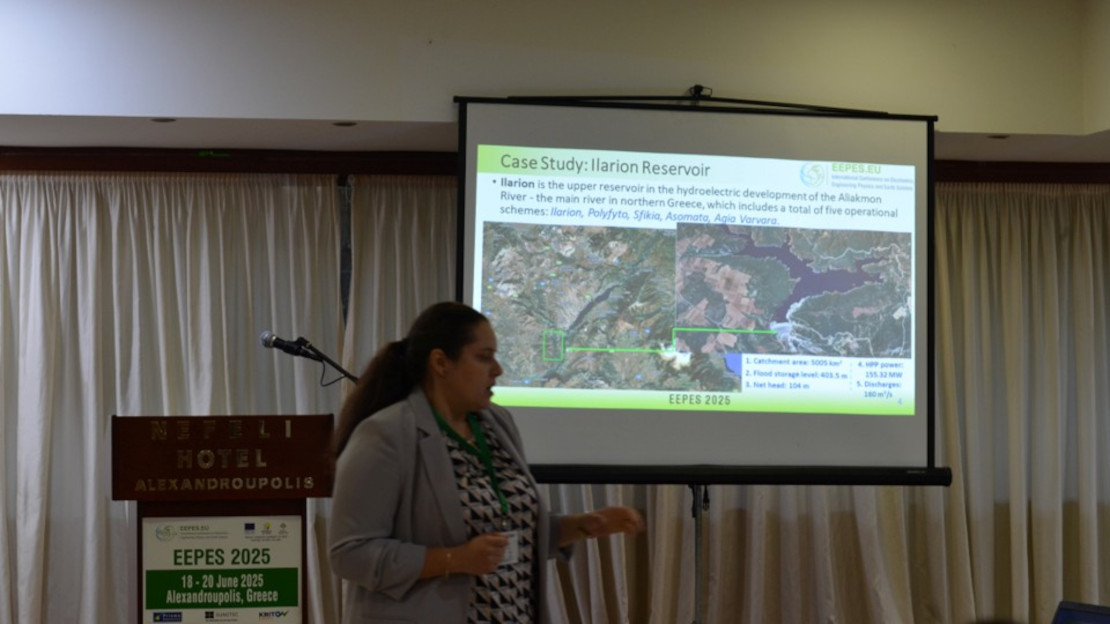
Eliza-Isabela Tică revealed how to model inflows into the Ilarion reservoir
Eliza-Isabela Tică from iAMP-Hydro project partner POLITEHNICA (National University of Science and Technology POLITEHNICA Bucharest) presented the work of modelling inflows into the Ilarion reservoir, highlighting the model's potential as a reliable tool for hydrological forecasting and water resource management in Western and Central Macedonia in Greece.
This work is important for planning the whole water complex of the Aliakmon River cascade.
Abstract. This study investigates the application of the Hydrologic Modeling System (HEC-HMS) for simulating inflows to the Ilarion Reservoir, the first reservoir in the cascade of five reservoirs along the Aliakmon River in northern Greece. The model is calibrated using observed meteorological and hydrological data to assess its performance and reliability in reproducing observed flows. Model accuracy is evaluated through statistical indicators such as the Nash–Sutcliffe Efficiency (NSE) and Percent Bias (PBIAS). The results demonstrate a satisfactory agreement between simulated and observed discharge, highlighting the model's potential as a reliable tool for hydrological forecasting and water resource management in the region.
Read the full paper HERE.
3. Daily inflow forecasting in Asomata reservoir, on Aliakmon River, using Long Short-Term Memory network
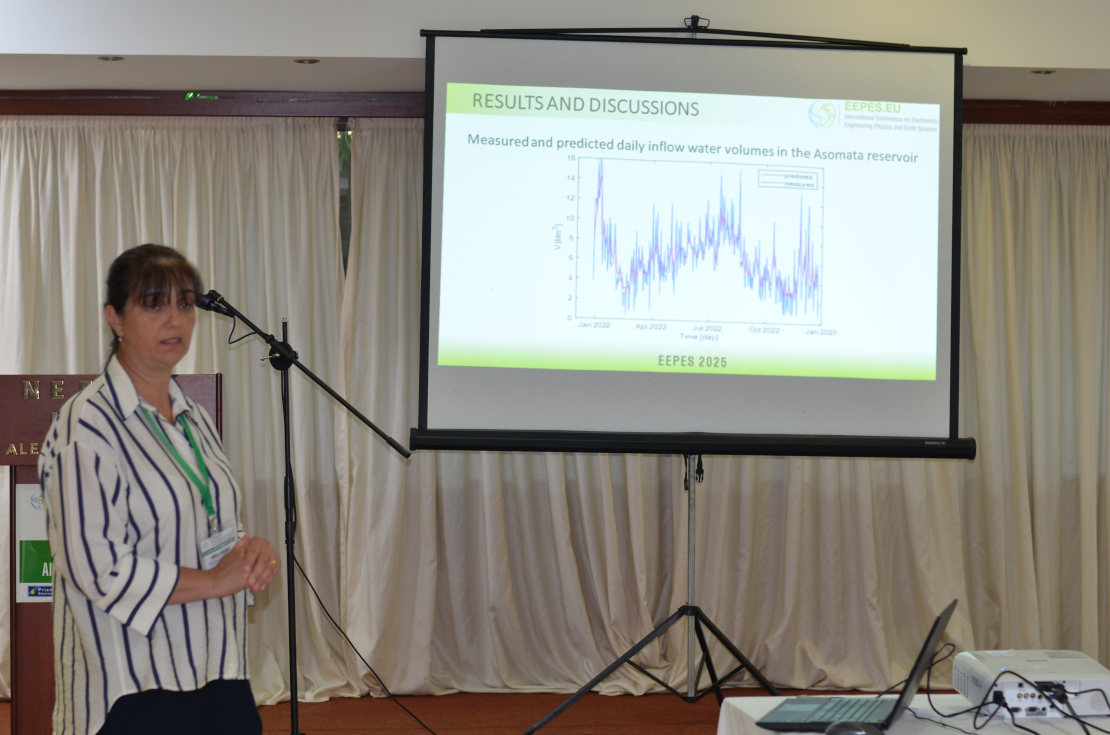
Angela Neagoe during her talk
Angela Neagoe from POLITEHNICA shared the findings of daily inflow forecasting into the Asomata reservoir (Aliakmon River in Greece) which will advise the operator PPC how to plan the water use in terms of energy and/or irrigation.
Abstract. In this paper, the forecast of the daily inflow water volumes in the Asomata reservoir, on the Aliakmon River, Greece, based on long short-term memory was realized. A MATLAB program was developed for one day ahead prediction; the model was calibrated for the period 2011- 2021 based on the historical values and used in a repetitive loop for 365 days corresponding to the testing year 2022. An improvement in the forecasting was observed when the daily index associated with the forecasted variable was used as input. This improvement was much more important than when the associated precipitation values were used in the absence of the day index. A possible explanation would be the operating
schedule of the plants upstream, Asomata reservoir being the fourth in a five reservoirs cascade. More than that, the upstream hydropower plant, Sfikia, is a pumped storage plant, Asomata being lower reservoir for this one. The results are in good agreement with the measurements, confirming the fact that long-short term memory networks are widely used in the hydrological forecasting with good results.
Read the full paper HERE.