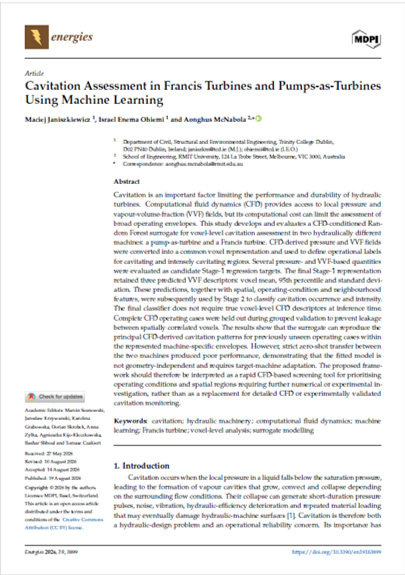
We are pleased to announce the publication of a new scientific paper exploring how Computational Fluid Dynamics (CFD) and Machine Learning can be combined to improve cavitation assessment in hydropower turbines. The study, prepared by Maciej Janiszkiewicz, Israel Ohiemi and Aonghus McNabola and published in the journal Energies, presents a novel methodology that enables rapid identification of cavitation-prone regions in both Francis turbines and Pumps-as-Turbines (PATs).
Cavitation remains one of the key challenges affecting the efficiency, reliability and lifetime of hydropower equipment, particularly as plants are increasingly required to operate flexibly to support renewable energy integration. To address this challenge, the researchers developed a two-stage machine learning framework trained on CFD simulation data, capable of predicting cavitation occurrence and intensity across a broad range of operating conditions.
The results demonstrate that the approach can successfully reproduce the main cavitation patterns identified by CFD simulations while significantly reducing the computational effort required for extensive operating-envelope assessments. Although not intended to replace high-fidelity CFD analyses, the framework offers a powerful screening tool that can support operators in identifying critical operating conditions and prioritising further investigations.
The work contributes directly to the iAMP-Hydro vision of developing intelligent digital solutions for the hydropower sector. By combining advanced simulation techniques with data-driven analytics, the research supports more reliable, flexible and sustainable hydropower operation and demonstrates the growing potential of digitalisation for asset management and condition monitoring.
Publication: Cavitation Assessment in Francis Turbines and Pumps-as-Turbines Using Machine Learning, published in Energies (2026). The research was supported by the iAMP-Hydro project, funded by the European Union's Horizon Europe programme.
Read the full paper here: https://doi.org/10.3390/en19163899